


















Enfield #4 .303 British Bolt Action Rifle
War and the Lee-Enfield
World War 1 versions of the Lee-Enfield are referred to as the SMLE, which stands for "Short, Magazine, Lee-Enfield" variant. Two British made versions were the No. 1 Mark III, and the No. 4 Mk 1 or 2. Both are more accurate and capable of better aim than 2 MOA with the.303 British. A handicap to the Lee-Enfield No. 1 was its open iron sights though. Soldiers had to have "very good" eyesight to squeeze all the accuracy out of the rifle. Lee-Enfields No.4 Mk 1 equipped with "war time flip aperture sights" was much easier to shoot. The No 4 could be shot accurately at speed better than the No 1. Post-war rifles of the Lee-Enfield No. 4 Mk 2 have excellent micrometer adjustable aperture sights and accuracy. We obtained a collection of Lee-Enfields, resembling rifles that were just turned in by a British Soldier. These bolt-actions have the same war marks collectors covet and would expect from a rifle from the battlefield. Lee-Enfields were chambered in.303 British or 7.7x56mmR, and featured a 25.2-inch barrel. The.303 British cartridge started as a black powder round and remained in service into the 1950s. Over seven decades in service to the British Commonwealth, the.303 British saw 26 variations. The 7.62x51mm NATO round eventually replaced the cartridge. War in the trenches changed battle tactics on all sides. By 1915, the advantage of Lee-Enfield's outstanding accuracy was negated. However, a few skilled marksmen would pop up and take shots at the enemy before ducking back down into trenches. Private Henry Norwest found fame with his Lee-Enfield and quick shooting. A Metis Indian, Norwest could take his Lee-Enfield rise, aim, fire, and reload before firing again in two seconds or less. Private Norwest was thought to have killed 115 enemy troops before sniper fire took him down in 1918.The Battlefield
Lee-Enfield rifles are robust, extremely reliable, and highly effective during sniper operations. 10 shot magazines were twice the capacity of its counterparts. Small units like those of Private Henry Norwest and Private Frank Richards could lay down massive rates of fire against heavily armed enemy troops. Through every variant, Lee-Enfields were admired for their exceptionally smooth bolt action. Nearly every soldier praised the rapid-fire ability, by the magazine and stripper clips. The British were considered the best trained military force in the world. It is said a British marksman could hit a target 300 yards away, 30 times in 60 seconds. It was called the "Mad Minute." Living in a world with automatic firearms and laser sighting, this would seem a simple task. But get your hands on a Lee-Enfield and try the same exercise and the difference is clear. In 1914, a musketry instructor by the name of Sergeant Snoxall set the current world record. Sergeant Snoxall placed 38 rounds into a 12-inch wide target at 300 yards in one minute. Again, if you think it's easy buy a Lee-Enfield from Classic Firearms and try it yourself. Early in development, the British opted for the shorter Enfield barrel rather than its longer predecessor. Deeper five groove Enfield rifling offered exceptional accuracy. The combination of a shorter barrel with Lee's bolt-action proved to be the trick that made the rifle one of the best.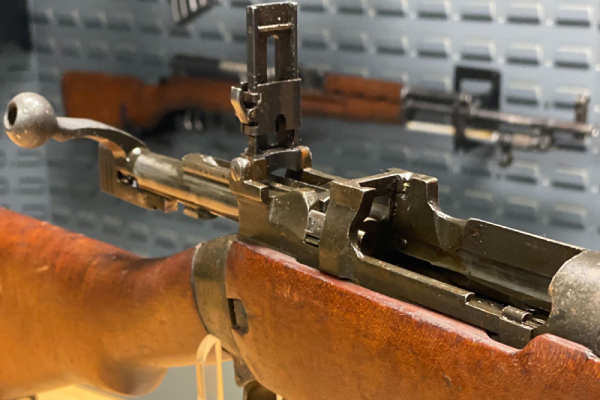
Enfield #4 .303 British Bolt Action Rifle - Good Condition
Lee-Enfields were chambered in.303 British allowed troops to fire on targets 800 yards away. Platoon volley fire reached nearly 1500 yards. The rifle was capable of sustained, accurate, and lethal fire over 1000 yards, and they had excellent stopping power. Trenches in France and Flanders were sloppy, with plenty of mud and debris to gum up the actions on most rifles. Not so for the Lee-Enfield. The rifle's "cock on close action" was smooth and offered plenty of room for the mud after it recycled the mechanism. The.303 British cartridge in the headspace allowed for a little slop in the trenches. By all accounts, Lee-Enfields had good ergonomics for a rifle conceived in 1891. (The word ergonomics was not even recognized until 1947) Its iron sights were suited for the battlefield and complemented long-range target work. (sniper)
Final Thoughts
There are only a few firearms in this world that last through generations of civilians and soldiers. The Lee-Enfield rifle is one of the most widely used bolt-action rifles in the world. The sun never sets on the Empire, or at least that is the way the British described it. The British Empire created a rifle that has endured for more than a century. As a matter of fact, the Lee-Enfield was so good it outlasted the Empire itself. How many rifles can gloat like that? Shop All C&R EligibleShop All Military Surplus Long Guns



 Loading...